
When a nest needs a professional
A paper wasp nest the size of a walnut under a patio chair is a nuisance. The same nest in August, at the size of a dinner plate and holding a few hundred insects, is a different situation, and it is the one people call us about.
Wasps get more aggressive as the season goes on. The colony peaks in late summer, the food supply tightens, and defence of the nest sharpens. That is when a knocked nest turns into a swarm and stings. Anyone in the household with a sting allergy changes the risk entirely, and that job is not a ladder-and-a-can job.
We answer the phone 24 hours a day, which matters for wasps more than almost anything else we treat.
What we remove
- Paper wasps: the open, umbrella-shaped combs under eaves, patio covers, deck rails and playsets.
- Yellowjackets: the ground and cavity nesters. Aggressive, and the ones responsible for most late-summer stings.
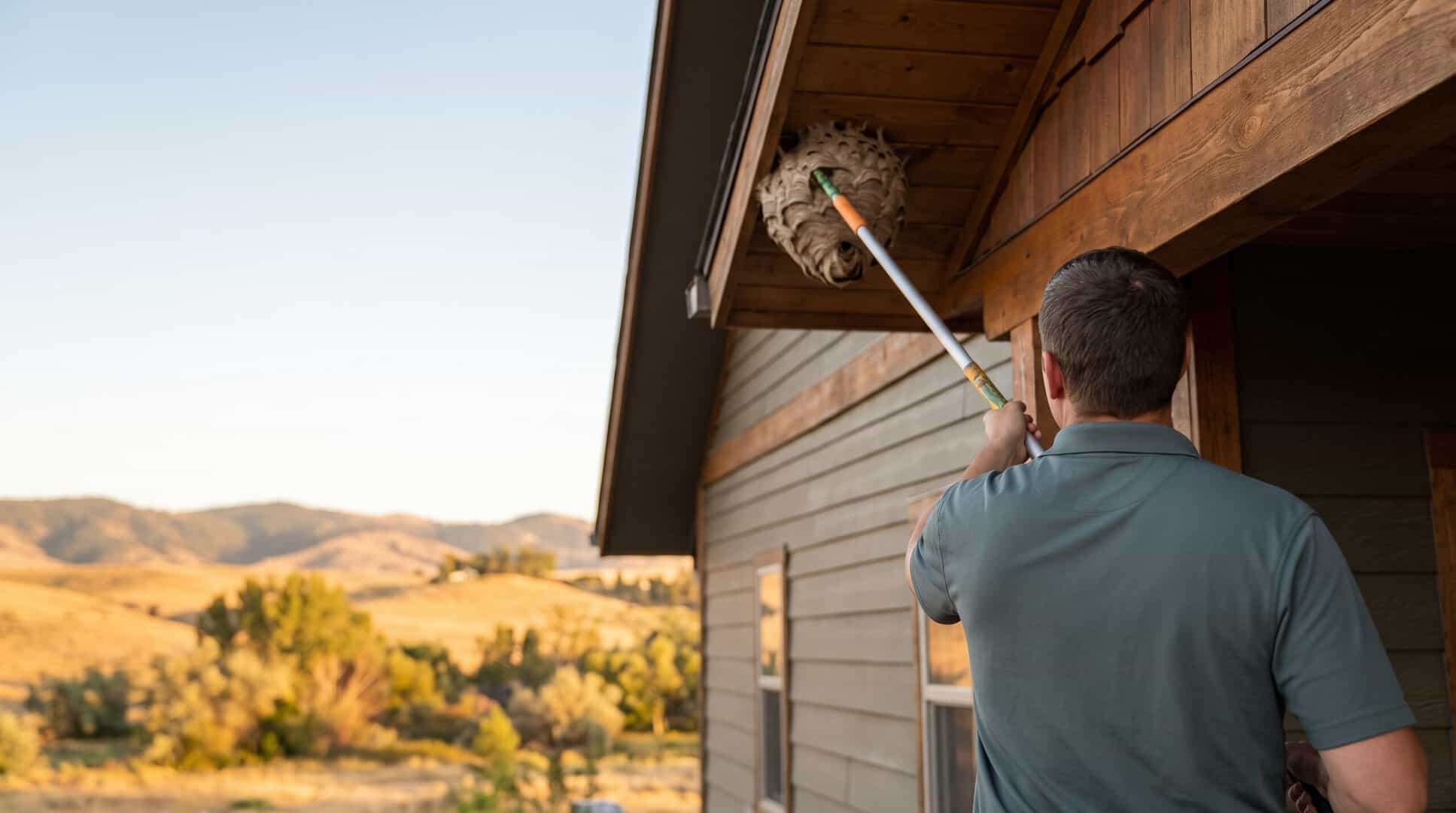
- Bald-faced hornets: the large grey football-shaped nests in trees and on the sides of houses.
- Mud daubers: mostly harmless, but they leave tubes on siding and in sheds.
The nest comes down, and then we treat the site it was attached to. That second step is the one that stops the rebuild, because a good nesting spot stays a good nesting spot and next year’s queen will find it.
Bees are different, and we treat them differently
If it turns out to be honey bees, that is not a job for a pesticide. Honey bees are pollinators and worth protecting, and a colony in a wall also brings a comb and honey problem that spraying does not solve. We will tell you plainly if that is what you have, rather than treating it as a wasp job.
Do not knock it down yourself
The two things that go wrong are predictable. People spray a nest at midday, when most of the colony is out foraging and comes back to a damaged nest and an exposed person. And people knock a nest off a ladder, which leaves them elevated with nowhere to go.
How the removal works
The technician treats the nest first, at a distance, so the colony is neutralised before anything gets physically removed. Then the nest comes down. Then, and this is the step that matters, the attachment site gets treated so the spot stops being attractive.
Timing is deliberate. Nest work is done early or late, when the colony is home and calm, rather than midday when half of it is out foraging and will return to a damaged nest and an exposed person.
Where the nests actually are
People find the nest they can see. Your technician looks for the ones they cannot:
- Under eaves, soffits, patio covers, deck rails and the underside of outdoor furniture.
- Inside the BBQ, the playset tubing, and the corner of an unused shed.
- In the ground. Yellowjackets nest in old rodent burrows and irrigation boxes, and people find them with a lawnmower.
- Inside wall voids and attic spaces, entering through a gap you would never notice.
- In the shrub line, which is why a hedge trimmer is a common way people get stung.
Wasps get worse as the summer goes on
A paper wasp nest in June is small and the colony is docile. The same nest in late August holds several hundred insects, the food supply outside has tightened, and the colony is defending a full brood. Aggression climbs steeply, which is why almost all of the stings we hear about happen in the last weeks of summer.
Treating in early summer, when the nest is small and the queen is still building, is dramatically easier and safer than treating in September. If you are seeing a nest start, that is the moment to call, not after it has become a problem.
Cost and availability
Wasp and hornet work is included in the general pest control plan, and we take it as a standalone emergency call too. We answer the phone 24 hours a day, which for a nest by a doorway with a sting-allergic kid in the house is the entire point.
Wasps are not bees, and the difference is worth knowing
People call about “bees” far more often than they actually have bees. In this valley the vast majority of stinging insect calls are paper wasps, yellowjackets or hornets.
The practical difference: wasps are smooth-bodied, can sting repeatedly, get aggressive late in the season, and build the papery nests you see under eaves. Honey bees are fuzzy, are pollinators, and a colony in a structure comes with comb and honey that will attract other pests if it is killed and left in a wall. We treat the first and we will tell you honestly if you have the second.
After the nest comes down
For a day or two you may still see a few wasps circling the spot where the nest was. Those are foragers that were out when the nest was treated, coming back to a home that is no longer there. They have nowhere to go and no colony to defend, and they die off quickly. It is normal, it is not a failed treatment, and it does not mean they are rebuilding.
Call it in. Wasp and hornet service is included in our general pest control plan, and we answer the phone at any hour for it, whether you are in Middleton, Garden City or anywhere else in the valley.