
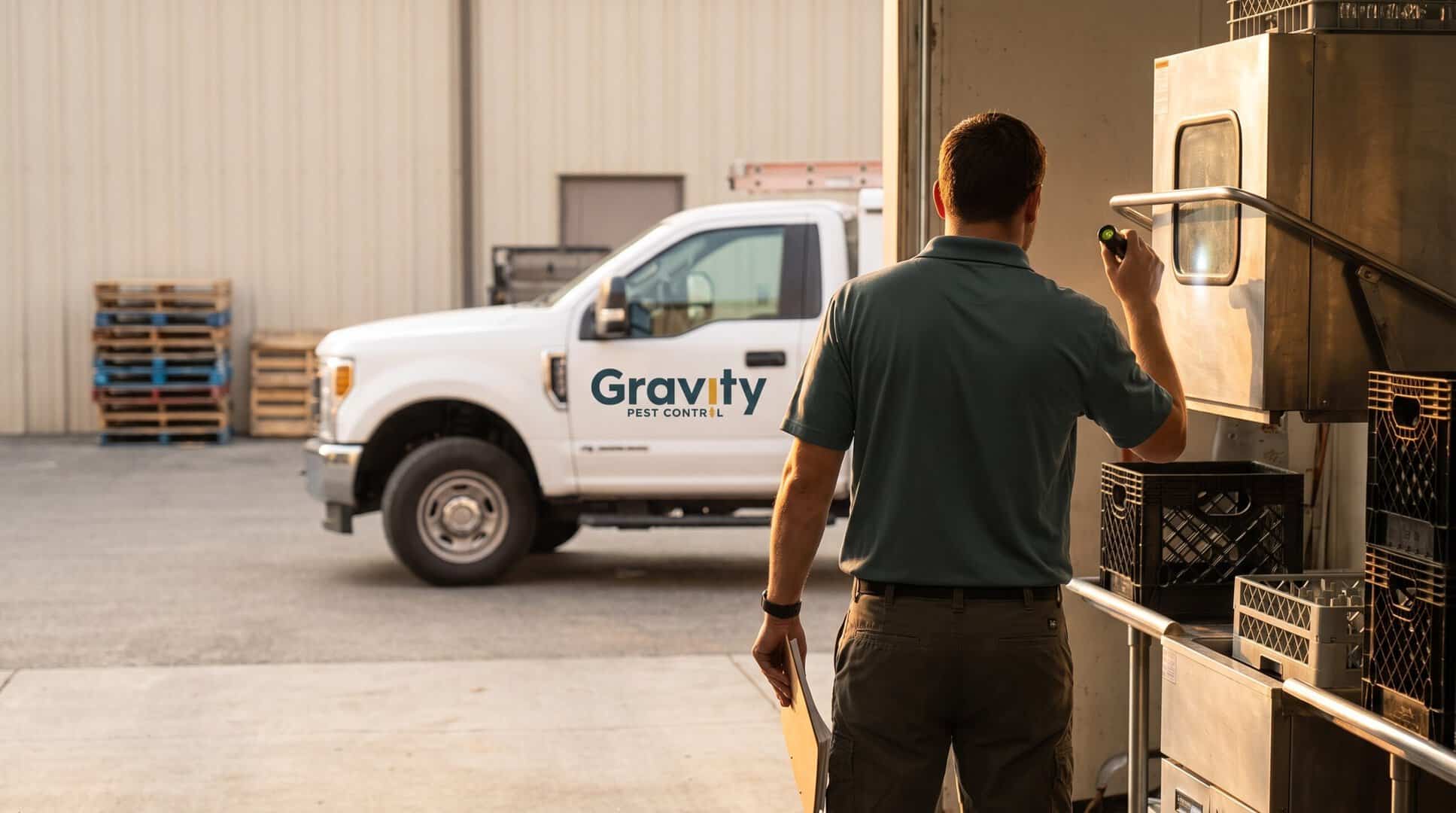
A pest problem in a business is a different problem
For a homeowner, pests are unpleasant. For a business, they are a health inspection, a bad review, a failed audit, or a tenant who stops paying rent. The pest is the same. The stakes are not.
So commercial work is run differently. It is scheduled around your hours instead of your customers. It is discreet. And it is documented, because at some point somebody is going to ask you to prove you have a pest control program, and a verbal assurance will not do.
Who we service
- Restaurants and food service, where cockroaches and rodents are a compliance failure, and where the kitchen has to keep running.
- Offices, where the problem is usually ants, spiders and the occasional rodent, and the requirement is that nobody notices us.
- Warehouses and storage, where loading docks and roll-up doors are open invitations and the perimeter is the whole game.
- Apartments, duplexes and rentals, where pests move between units through shared walls and treating one unit alone accomplishes nothing.
Documentation your inspector will accept
Every visit is recorded: what was found, what was treated, what was recommended, and what still needs fixing on your end. When an inspector or an auditor asks for your pest control records, you have them.
The conditions matter more than the spray
In a commercial building, the treatment is usually the easy part. What actually drives an infestation is a propped back door, a dumpster too close to the wall, standing water behind the ice machine, or cardboard stacked against a warm wall. We will tell you what we find, plainly, because treating around a structural problem is a way to keep billing you without fixing anything.
How commercial service is scheduled
Around you. A restaurant gets serviced before open or after close, not during the lunch rush. An office gets serviced when the staff are not sitting at their desks. A warehouse gets serviced without shutting down a dock. That is not a courtesy, it is the basic requirement of the job, and it is the first thing that separates a commercial pest program from a residential one done at a business.
The documentation, and why it matters
Every visit generates a record: what was found, where, what was treated, what was recommended, and what has not been fixed. That log is what you hand an inspector, an auditor or a franchisor when they ask whether you have a pest control program. A verbal assurance and a business card will not satisfy a health inspection.
It also protects you. If a problem recurs and we have been telling you for four visits that the back door is being propped open at night, that is on the record.
What actually causes commercial infestations
Almost never the absence of pesticide. In our experience it is nearly always one of a short list of structural and operational problems:
- A back door propped open in summer, which is an open invitation for flies, rodents and roaches.
- A dumpster sited too close to the building, or one that is not being closed.
- Standing water behind the ice machine or under the three-compartment sink.
- Cardboard stacked against a warm wall, which is both harbourage and food for roaches.
- A loading dock seal that has been damaged for a year.
- Grease under equipment that has not been pulled out and cleaned in months.
We will tell you which of these you have. Treating around a structural problem is a way to keep billing a client without ever solving anything, and we would rather have an uncomfortable conversation than that relationship.
Multi-unit and rental property
Apartments, duplexes and rentals are their own category, because pests move through shared walls, plumbing chases and ceiling voids. Treating one unit while the unit next door is untreated accomplishes very little. For landlords and property managers we treat the building as the unit, which is both more effective and cheaper than a series of one-off callouts.
Getting ahead of an inspection
If you have a health inspection coming, tell us. There is a meaningful difference between a routine service visit and a pre-inspection walkthrough, where the technician goes through the building looking at it the way an inspector will and tells you what would get written up.
That includes the things that are not strictly pest control: the gap under the back door, the standing water, the cardboard, the dumpster. An inspector will note those as conditions conducive to pests whether or not there is a single insect on the premises.
Discreet service around your customers
Nobody wants a pest control truck parked at the front door of their restaurant at seven in the evening. Service happens when your customers are not there, technicians are not walking through your dining room in uniform at peak hours, and if you want the vehicle parked around the back, say so and it will be.
Gravity Pest Control services businesses across the Treasure Valley, from restaurants and rentals in Boise to warehouses and shops in Nampa, and we answer the phone 24 hours a day.