
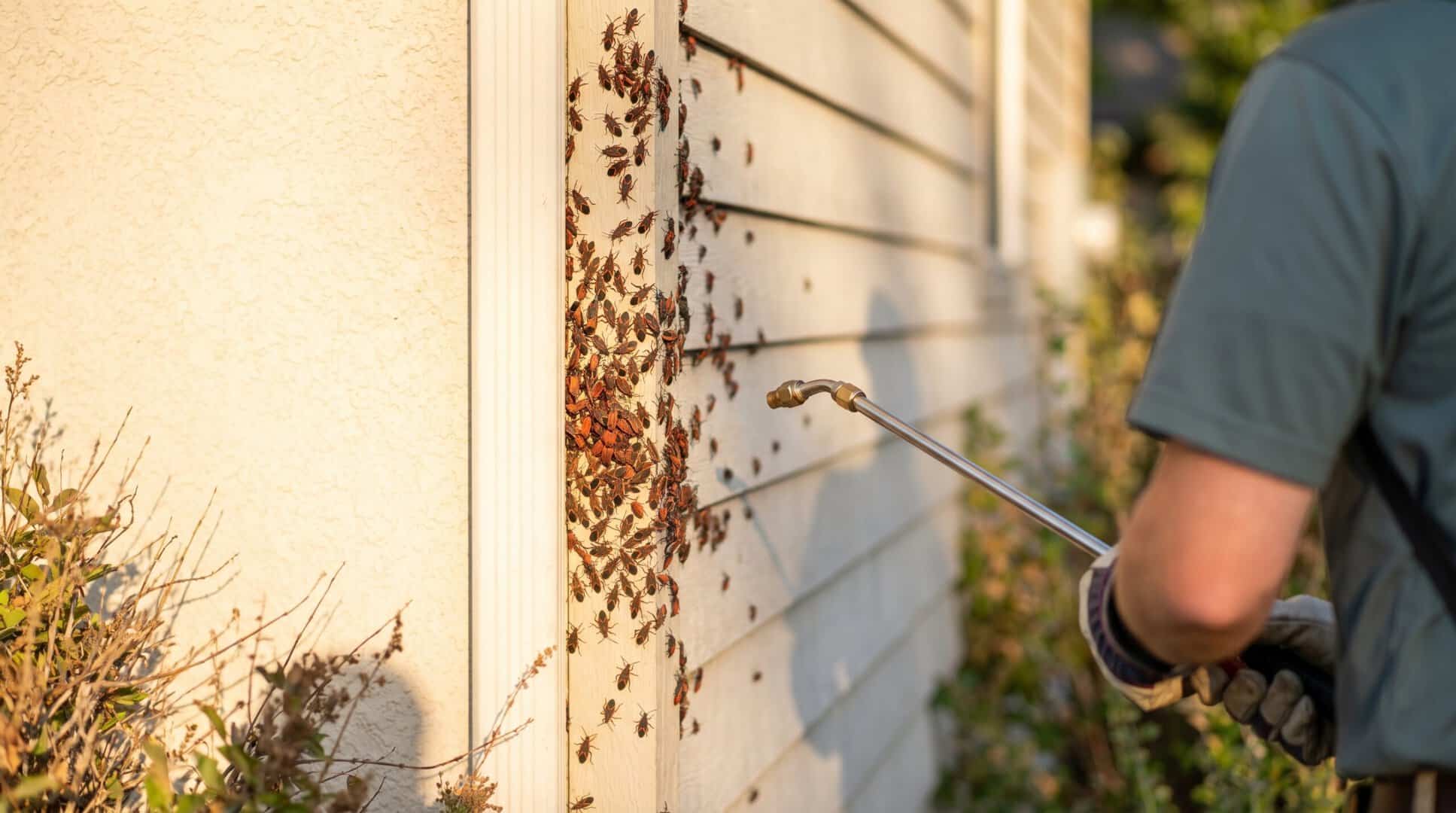
Why your south wall is covered in them
Boxelder bugs are one of the most recognisable pests in the Treasure Valley, and one of the most misunderstood. They do not bite, they do not sting, and they do not damage the structure. They simply arrive by the hundreds, cover the warmest wall of your house, and then start finding their way inside.
The pattern is the same every year. Through the summer they feed on boxelder, maple and ash trees. When the nights cool off in the fall, they look for somewhere warm to overwinter, and the warmest surface available is the south or west facing wall of a house that has been in the sun all afternoon. From there they work into the gaps: siding seams, window frames, weep holes, attic vents and the space behind trim.
Then they go quiet. In the middle of winter, a warm spell or a heated wall wakes some of them up, and they turn up in your living room in January with no obvious way in.
The timing is everything
This is the pest where calling at the right time matters more than anything else we treat. Once boxelder bugs are inside the wall void, the options get poor: sprays cannot reach them, and killing them in the wall leaves bodies that attract other insects.
The treatment window is early fall, as they start massing on the exterior and before they get in. We treat the sunny walls, the eaves and the gaps around penetrations while they are still on the outside of the building. That is what stops the interior problem in January.
What we do
- Treat the south and west facing walls where they gather in the fall.
- Treat the entry gaps: siding seams, window and door frames, utility penetrations, vents and soffits.
- Point out the exclusion work worth doing, like sealing gaps and fixing damaged screens, since sealing is the permanent half of the fix.
- Look at the trees. A boxelder tree right against the house is the source of the population, and it changes the plan.
What not to do
Do not vacuum them up and expect that to solve it, and do not crush them on the siding. They release a stain and an odour, and the population outside is far larger than the handful you can see. Spraying them individually on a wall does almost nothing, because the ones you are killing are a fraction of the group that will still be there tomorrow.
Why they are not actually harmful, and why that does not help
Boxelder bugs do not bite, do not sting, do not carry disease and do not damage the structure. Every pest control company will tell you that, and it is true. It is also cold comfort when there are four hundred of them on the side of your house and a dozen crawling across the living room window in January.
They are a nuisance pest, and the nuisance is real. They stain when crushed, they release an odour, they get into light fixtures and window tracks, and they turn up indoors months after you thought they were gone.
The tree is usually the answer
Boxelder bugs feed almost exclusively on boxelder, maple and ash. If your house is getting hit hard year after year and your neighbour’s is not, look at what is growing within a hundred feet of the wall.
We are not going to tell you to cut down a healthy shade tree, and a female boxelder tree is the specific host worth knowing about. But knowing where the population is coming from changes where we treat and how much treatment is worth doing. It is a genuinely useful thing to find out.
Exclusion is the permanent half
Treatment on the wall handles the population that is there now. Sealing is what stops next year. The gaps that matter are the ones nobody looks at:
- Siding seams and the gap where siding meets trim.
- Window and door frames, especially on the south and west sides.
- Weep holes in brick, which are meant to be open but can be screened.
- Utility penetrations, dryer vents and attic vents with damaged screen.
- The gap under a worn door sweep.
Cost and timing
Boxelder work is part of the general pest control plan, and the plan is worth having specifically because of the timing problem: the treatment window is short, it is in early fall, and it is easy to miss. A recurring plan means somebody is already scheduled to be at your house at the right moment.
Boxelder service is included in our general pest control plan. The older properties around Emmett and Notus have the mature trees that feed the population, so they see it worst, but any house with a sunny wall can get them.