
Spiders are a symptom
A spider in the corner of your garage is there because something it eats is there too. Spiders follow the insect population, which is why knocking down webs is such short-lived work. The webs are back in a week because the food never left.
So spider control is really two jobs. Remove the spiders and the egg sacs you have now, and take away the insects drawing them in. Do the second part and the problem stops repeating.
What we do about it
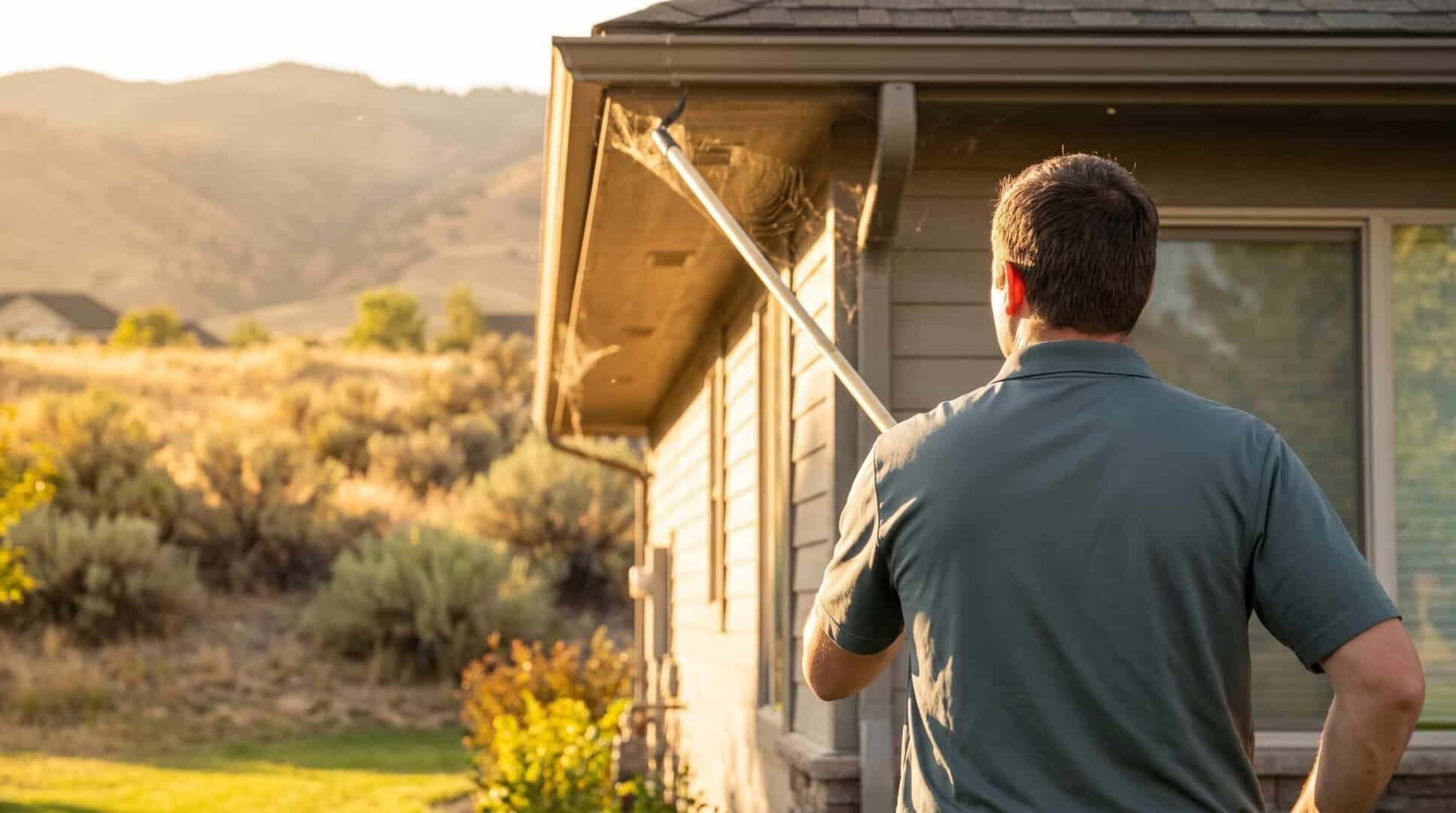
Your technician works the places spiders actually sit and hunt, which are rarely the places you notice them:
- Eaves, soffits and window frames, where webs get built overnight and rebuilt as fast as you clear them.
- Garage corners, door tracks and window wells, the cool dark edges they hunt from.
- Landscaping rock, woodpiles and siding gaps against the foundation, where they harbour out of sight.
- Exterior lighting, which pulls in the flying insects that feed the whole population.
We de-web the structure, treat the harbourage, and run the perimeter service that drops the insect population the spiders are living on.
The spiders worth knowing here
Most of what you will find in a Treasure Valley home is a nuisance, not a danger: cellar spiders, common house spiders and the fast wolf spiders that come in off the fields and get noticed because they run.
Black widows do live in this area. They favour undisturbed, sheltered spots close to the ground, which means window wells, meter boxes, crawlspace vents, stacked wood and the underside of patio furniture that has not moved all summer. If you find one, do not handle it. Tell your technician where it was, and he will treat that harbourage directly.
Keeping them out
What the service includes
De-webbing first. The technician clears the webs and the egg sacs from the eaves, soffits, window frames, corners and the places you cannot reach, because leaving egg sacs behind means the population rebuilds itself from your own house.
Then treatment lands on the harbourage: the cool dark edges spiders sit in, the gaps in siding, the landscaping rock and woodpiles against the foundation, the window wells, and the garage door track. And then the perimeter service that knocks down the insect population they are eating, because that is the part that actually keeps the numbers down.
Why the garage is always the worst room
It is the most common complaint we get, and there is a reason for it. A garage has an unsealed door at the bottom, exterior lighting right outside that pulls in flying insects all night, cool dark corners, and stored boxes nobody moves. That is a spider’s ideal habitat, sitting directly attached to your house.
Fixing the garage door seal and switching the exterior fixture to a warm bulb that attracts fewer insects does real work here, and it costs almost nothing. We will tell you that even though it is not something we bill for.
What you can do yourself
- Pull woodpiles, boards and stored materials away from the foundation and up off the ground.
- Clear the landscaping rock and mulch back a few inches from the wall.
- Switch exterior lights to warm-toned bulbs. Fewer insects means fewer spiders.
- Keep the garage door seal in good repair.
- Knock down webs as you see them, which discourages rebuilding in the same spot.
What it costs
Spider work is priced with the general pest control service rather than sold as a separate one-off, because treating spiders without treating the insects they eat is money spent on a symptom. You can price it online in about two minutes.
Egg sacs are the part people miss
A single egg sac can hold dozens to hundreds of spiderlings, and they are usually tucked exactly where nobody looks: the top corner of a garage, the back of a window well, the underside of patio furniture, inside an unused planter. You can clear every visible web on the property and still have the next generation waiting in place.
Removing the sacs is a deliberate part of the service, and it is the reason a proper de-web is worth more than running a broom around the eaves.
Spider season in the Treasure Valley
Spider activity tracks the insects they eat, so it climbs through the summer and peaks in late summer and early fall. That is also when the big, obvious webs appear and when people start calling. Treating through the season keeps the population from ever getting there, which is easier than knocking it down at its peak.
Spider work holds when the perimeter service holds, because the food supply is what actually controls the population. Spider treatment is part of our general pest control plan, and we run it across the valley, including the foothill properties around Eagle and the newer subdivisions in Star.